Non-Functional Design Requirements: Importance and Impact
Imagine building a car navigation system. It needs to let drivers input a destination and see a route on the screen—this is a functional requirement. Functional requirements describe “what” the system does. Similarly, a web application’s login feature or a shopping site’s “Add to Cart” button are examples of functional requirements—they define specific actions the system must support.
However, non-functional requirements (NFRs) determine “how well” the system performs. For instance, if the navigation system must calculate a route in under a second regardless of traffic, that’s a non-functional requirement. These include performance, reliability, scalability, and security, setting operational benchmarks for the system.
Functional requirements say, “You can log in with a username and password.” Non-functional requirements say, “The system should handle ten thousand logins at once without slowing down.”
Non-functional requirements often go unnoticed until a system fails to meet them. From a user’s perspective, they are the difference between a smooth experience and frustration. For businesses, neglecting NFRs can lead to financial losses, reputational damage, and regulatory fines.
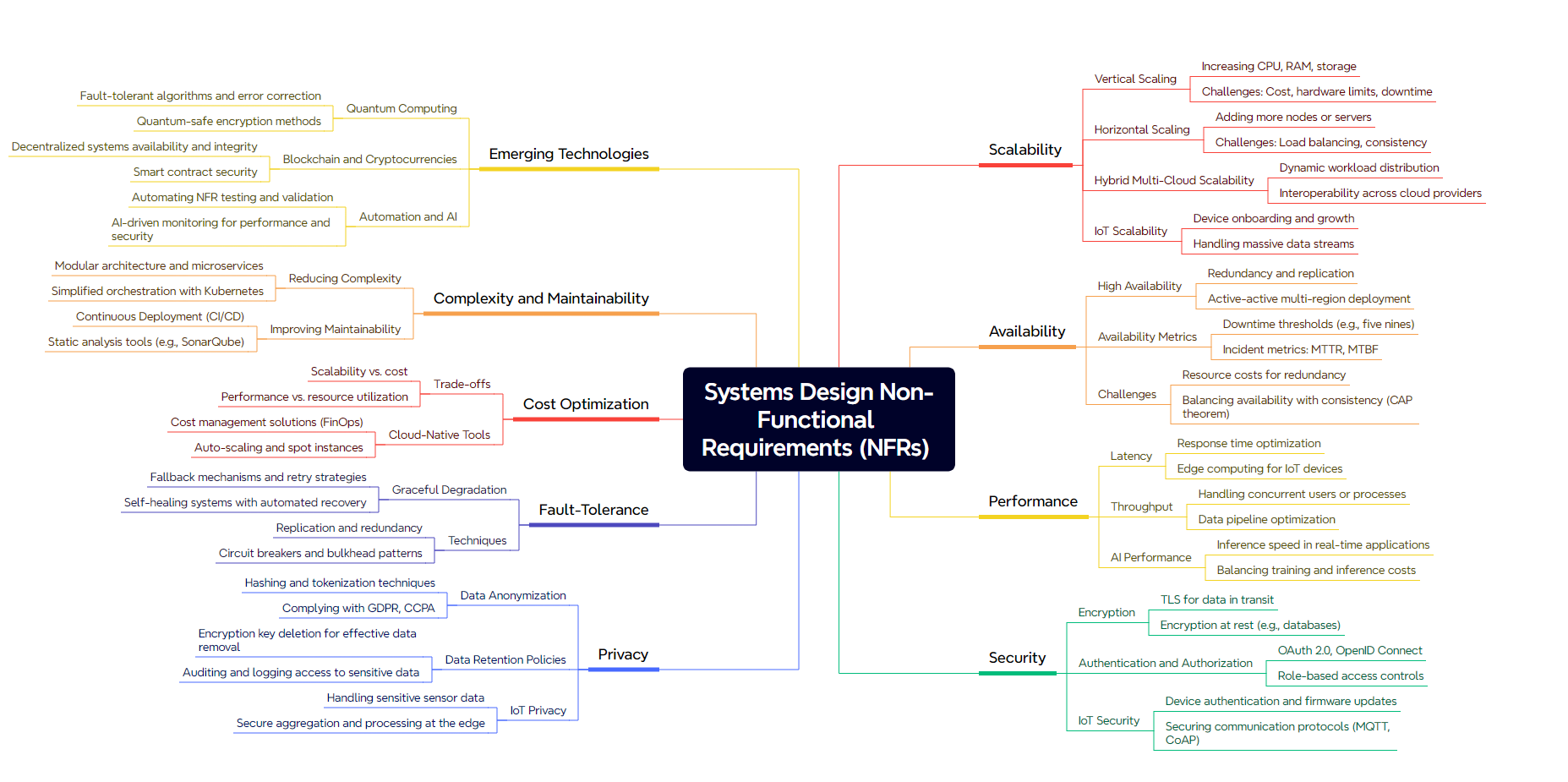
Figure: Mind Map of Non-Functional Requirements (NFRs)
Real-World Impact
Lessons Learned: The platform could have benefited from:
- Stress testing tools like Apache JMeter to simulate high traffic loads.
- Scalable cloud infrastructure using auto-scaling groups in AWS, Azure, or Google Cloud.
- Distributed load balancers like NGINX or HAProxy for better traffic management.
Key Categories of Non-Functional Requirements
- Scalability: Ensure systems can handle growth in users and data. Best Practice: Use auto-scaling and load balancing to accommodate sudden spikes in traffic.
- Availability: Keep systems operational with minimal downtime. Best Practice: Deploy multi-region failovers and redundancy to achieve “five nines” availability.
- Performance: Optimize response times and throughput. Best Practice: Use content delivery networks (CDNs) and caching for faster responses.
- Security: Protect data from unauthorized access. Best Practice: Implement encryption for data in transit and at rest, and conduct regular security audits.
- Privacy: Ensure compliance with regulations like GDPR. Best Practice: Anonymize sensitive user data and implement clear retention policies.
Resources for Deeper Understanding
- “Designing for Scalability” by Martin Fowler
- AWS Well-Architected Framework
- Snyk: Security Testing for Modern Applications
- Apache JMeter: Performance Testing Tool
- NGINX: Load Balancing and Traffic Management
Conclusion
Non-functional requirements shape how users perceive and interact with your system. Neglecting them can result in slow, unreliable, or insecure systems. By identifying and prioritizing NFRs early, you can create robust solutions that meet both user and business needs.
Actionable Steps:
- Start by identifying critical NFRs during project planning.
- Conduct regular testing, such as load testing or security assessments.
- Use tools like Apache JMeter, Snyk, and SonarQube for validation.
Join the Discussion
What challenges have you faced in addressing non-functional requirements in your projects? How do you balance performance, security, and scalability? Share your experiences and lessons learned in the comments below!