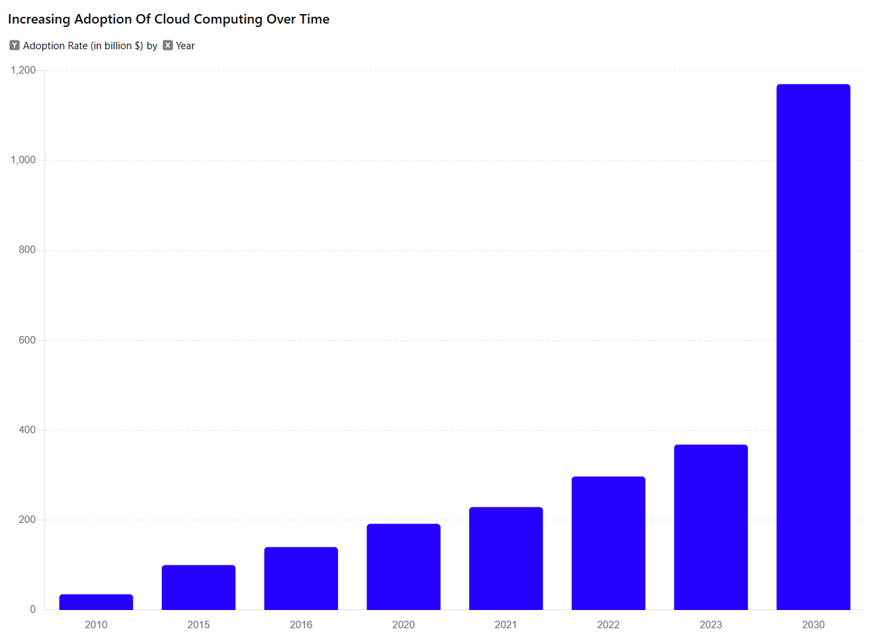
Recent projections for the cloud computing market size in 2030 from various sources are as follows:
- CloudZero: $1,600 billion
- Fortune Business Insights: $2,291.59 billion
- Precedence Research: $1,600 billion
- Grand View Research: Implies a figure around $2,400 billion based on their 2023 estimate and projected CAGR.
Introduction
The evolution from traditional on-premises infrastructure management to cloud-based solutions marks a significant paradigm shift in how organizations handle IT responsibilities. This article explores the change from a historical perspective, categorizes the new model’s responsibilities, and examines the broader impact on infrastructure and software complexity. I aim to provide a vendor-neutral understanding of this transformative change by analyzing the shared responsibility model across various cloud service providers.
The rise of cloud computing has fundamentally altered the landscape of IT infrastructure management. Historically, organizations were solely responsible for every aspect of their infrastructure and applications. However, the advent of cloud service providers (CSPs) such as AWS, Azure, Google Cloud Platform (GCP), and IBM Cloud has shifted many responsibilities from the developers and IT teams to the platform providers. This shift allows organizations to focus more on innovation and product development rather than the cumbersome task of managing infrastructure.
Historical Context
Traditional IT Management
In the traditional model, managing IT infrastructure was a labor-intensive process. Organizations needed to procure, deploy, and maintain hardware. Scaling infrastructure to meet demand involved significant time and resource investment. Software, in contrast, offered more flexibility but was still bound by the limitations and complexities of the underlying hardware.
Emergence of Cloud Computing
The introduction of cloud computing by CSPs revolutionized this scenario. By offering scalable, on-demand resources, CSPs have enabled organizations to deploy and scale their infrastructure globally with minimal effort. This shift has been pivotal in transforming businesses’ operations, driving efficiencies, and enabling rapid innovation.
Categories of Responsibility in the Cloud Model
The shared responsibility model in cloud computing delineates the security and management tasks between the CSP and the customer. We generally divide this model into two main categories:
Security of the Cloud
- Provider Responsibility: The CSP protects the infrastructure that runs all cloud services, including the physical security of data centers and the security of the hardware, software, networking, and facilities.
Security in the Cloud
- Customer Responsibility: Customers must secure their data and manage service configurations. The extent of these responsibilities varies depending on the service model (IaaS, PaaS, SaaS) and the specific services used.
Analysis of the Shared Responsibility Model
Infrastructure as a Service (IaaS)
In IaaS, CSPs provide the fundamental infrastructure, including virtual machines and storage. Customers are responsible for managing the operating systems, applications, and data. This model offers significant flexibility but requires substantial management effort from the customer.
Platform as a Service (PaaS)
In PaaS, CSPs manage the underlying infrastructure and platform, including operating systems and runtime environments. This relieves customers from the operational burden and allows them to focus on deploying and managing their applications and data. This model reduces the operational burden on customers while still providing flexibility.
Software as a Service (SaaS)
In SaaS, CSPs handle everything from the infrastructure to the applications. Customers use the software over the Internet. This model offers the least management overhead for customers but provides the least flexibility in terms of customization.
Best Practices for Managing Responsibilities
As cloud adoption grows, organizations must develop and implement best practices for managing their responsibilities within the shared responsibility model. Key areas of focus should include:
- An organization’s security posture must be continuously monitored and managed to ensure compliance with industry standards and regulations. This process includes implementing identity and access management (IAM) policies, conducting regular security assessments, and detecting proactive threats. For instance, advanced threat detection tools like AWS GuardDuty or Azure Security Center can provide real-time insights and automated reactions to potential threats.
- Configuration Management: Effectively managing cloud service configurations is paramount to maintaining security and operational efficiency. Automated tools for configuration management, continuous integration, and continuous deployment (CI/CD) pipelines can help streamline these processes and reduce human error. Services like IBM Cloud’s DevOps Toolchain offer comprehensive solutions for managing complex environments efficiently.
- Data Governance: Protecting sensitive information and ensuring data integrity requires clear policies and practices. These include data classification, encryption, and regular audits to ensure compliance with data protection regulations. For example, Google’s Cloud Data Loss Prevention (DLP) API helps organizations classify and protect sensitive information stored in the cloud.
Impact of Emerging Technologies
The rapid evolution of technology continues to shape the cloud computing landscape. Key emerging technologies that warrant further investigation include:
- Edge Computing: Processing data closer to its source can reduce latency and improve performance for time-sensitive applications. Organizations are increasingly integrating edge computing with cloud services to improve system efficiency and security, including analyzing use cases in healthcare, manufacturing, and autonomous vehicles to understand specific benefits and implementation challenges. For instance, IBM’s Edge Application Manager and IBM Satellite allow for autonomous management of workloads on edge devices, enhancing local processing capabilities.
- Serverless Architectures: Serverless computing abstracts infrastructure management further, allowing developers to focus solely on code. Organizations should examine the implications of serverless architectures on the shared responsibility model, identify best practices for leveraging this technology, and explore cost optimization, performance tuning, and security considerations specific to serverless environments. AWS Lambda and Azure Functions are prime examples of serverless services that streamline operations and reduce overhead.
- AI-Driven Automation: Artificial intelligence and machine learning can significantly enhance automation in cloud management, from predictive maintenance to security threat detection. Investigating the potential of AI-driven automation can reveal opportunities to optimize cloud operations and improve resilience, including developing AI algorithms for anomaly detection, resource optimization, and automated incident response. Solutions like IBM’s WatsonX Platform and Google’s AI Hub facilitate the integration of AI into cloud operations, driving smarter and more efficient processes.
Multi-Cloud Integration and Interoperability
As organizations increasingly adopt multi-cloud strategies to avoid vendor lock-in and optimize their workloads, understanding the challenges and opportunities of multi-cloud environments becomes a key area of focus, including:
- Interoperability Standards: Developing standards and protocols to ensure seamless integration and interoperability between different cloud platforms includes creating APIs, data formats, and communication protocols that enable consistent and reliable interactions across multiple cloud environments. Projects like the Cloud Native Computing Foundation (CNCF) are working towards creating interoperable tools and practices for multi-cloud environments.
- Unified Management Tools: Creating tools that provide a unified view and control over multi-cloud environments empowers enterprises, simplifies management, and reduces complexity, which includes developing dashboards, monitoring systems, and orchestration tools that can operate across different CSPs. Solutions like IBM’s Multi-cloud Manager allow enterprises to manage and orchestrate cloud environments from a single interface.
- Cost Optimization Strategies: Identifying strategies to optimize costs across multiple cloud providers while maintaining performance and compliance includes exploring pricing models, workload distribution techniques, and automated cost management solutions. Tools such as AWS Cost Explorer and Azure Cost Management + Billing provide detailed insights and optimization recommendations for multi-cloud cost management.
IBM Cloud Security and Compliance Center
A key tool in managing security and compliance across hybrid multi-cloud environments is the IBM Cloud Security and Compliance Center. This integrated suite helps define policies as code, implement controls for secure data and workload deployments, and assess security and compliance posture. Key features include:
- Cloud Security Posture Management (CSPM): Provides visibility into cloud assets, identities, misconfigurations, and risks, enabling organizations to create multi-cloud environments with built-in industry-based compliance protocols.
- Cloud Workload Protection Platform (CWPP): This platform secures containers, Kubernetes, OpenShift, and hosts with runtime security, container forensics, and incident response capabilities.
- Vulnerability Management and Cloud Detection and Response (CDR): This solution automates CI/CD pipeline security, blocks vulnerabilities before production, and provides real-time visibility to detect and prevent application drift.
The IBM Cloud Security and Compliance Center simplifies compliance and enhances security management, offering real-time insights across hybrid multi-cloud environments and critical workloads. This comprehensive approach supports proactive mitigation of security risks and helps organizations achieve audit readiness.
Conclusion
Cloud computing is significantly changing IT infrastructure management. Organizations can clearly define each cloud service provider’s (CSP) security and infrastructure responsibilities and obligations by adopting a multi-cloud strategy and embracing the shared responsibility model. Adopting a multi-cloud strategy and embracing the shared responsibility model enables organizations to leverage the unique capabilities of each CSP while maintaining granular control over their data, applications, and overall security posture. A hybrid multi-cloud digital transformation allows businesses to focus on innovation and growth, driving efficiencies across various sectors. Understanding and effectively managing the responsibilities in this evolving model is central to maximizing its benefits.
References
- AWS GuardDuty: https://aws.amazon.com/guardduty/
- Azure Security Center: https://azure.microsoft.com/en-us/services/azure-security-center/
- IBM Cloud DevOps Toolchain: https://www.ibm.com/cloud/devops
- Google Cloud Data Loss Prevention: https://cloud.google.com/dlp
- IBM Edge Application Manager: https://www.ibm.com/edge-computing
- IBM Satellite: https://www.ibm.com/products/satellite
- AWS Lambda: https://aws.amazon.com/lambda/
- Azure Functions: https://azure.microsoft.com/en-us/services/functions/
- IBM Watsonx Platform: https://www.ibm.com/watsonx
- Google AI Hub: https://aihub.cloud.google.com/
- Cloud Native Computing Foundation (CNCF): https://www.cncf.io/
- IBM Multi-cloud Manager: https://www.ibm.com/cloud/multicloud
- AWS Cost Explorer: https://aws.amazon.com/aws-cost-management/aws-cost-explorer/
- Azure Cost Management + Billing: https://azure.microsoft.com/en-us/services/cost-management/
- IBM Cloud Security and Compliance Center: https://www.ibm.com/products/security-and-compliance-center