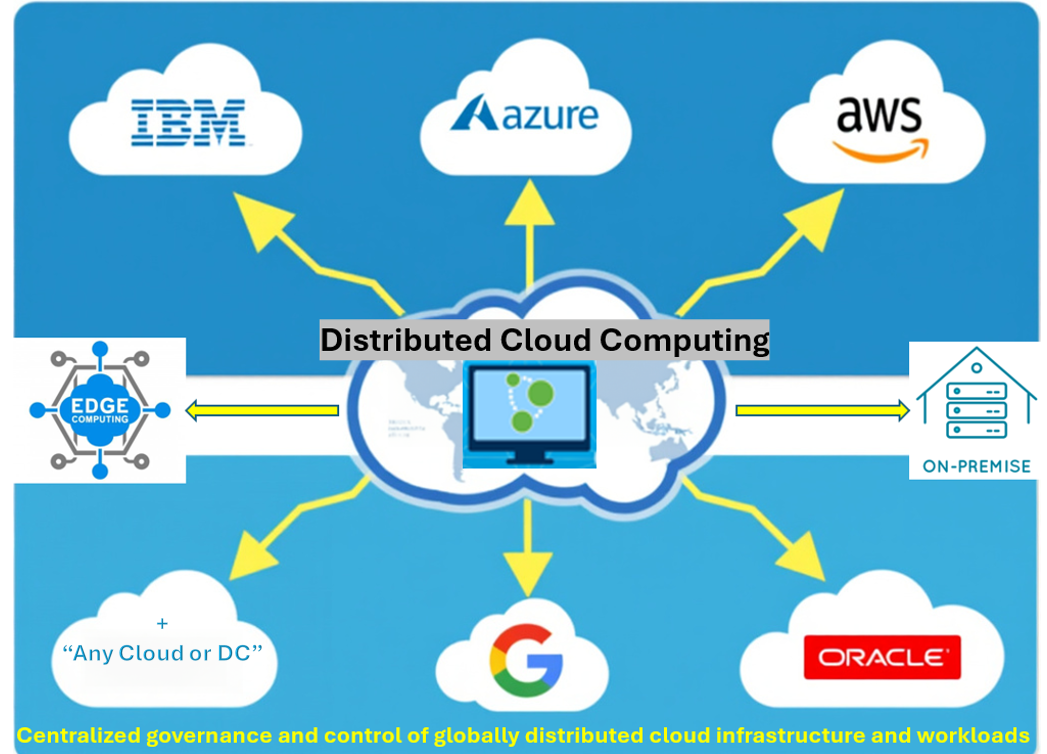
As businesses adopt the full scope of digital transformation, they encounter growing demands to distribute workloads across multiple regions and effectively manage both on-premises infrastructure and one or more public cloud environments while ensuring compliance with stringent data residency regulations.
Traditional cloud models—whether public, private, hybrid, or multi-cloud—fall short in offering the complete flexibility, scalability, governance, and centralized management required to deliver a truly integrated experience.
Distributed cloud computing provides a solution by extending cloud services across multiple public and private clouds, as well as edge locations, all while maintaining centralized control. This centralized management ensures operational consistency, security, and efficiency, equipping businesses with the tools needed for both operational and architectural success.
This blog will evaluate the distributed cloud offerings of five major public cloud providers: IBM Cloud Satellite, Azure Arc, AWS Outposts, Google Distributed Cloud (GDC), and Oracle Cloud Infrastructure (OCI). We will assess these solutions against the Distributed Cloud Reference Architecture (Reference 1) to determine which fully meets the criteria for a truly distributed cloud.
What Defines a True Distributed Cloud?
According to the Distributed Cloud Reference Architecture (Reference 1), a truly distributed cloud must:
- Provide a single, neutral control plane to manage heterogeneous infrastructure—public cloud, private cloud, on-premises, and edge—without vendor bias.
- Enable global orchestration and governance, ensuring consistent policy enforcement, security, and operational integrity across environments.
- Scale dynamically to meet performance, latency, and compliance requirements across geographies.
- Ensure flexibility in deployment, allowing workloads to move seamlessly across providers without vendor lock-in.
- Support multi-cloud interoperability, enabling enterprises to leverage each cloud provider’s best capabilities while maintaining full control of their data and operations.
In this context, IBM Cloud Satellite is the only complete solution that fully aligns with these principles. Other platforms, such as AWS Outposts and Google Distributed Cloud, are limited by their ecosystems, reducing multi-cloud flexibility and vendor neutrality. Let’s explore these offerings in detail.
1. IBM Cloud Satellite: The True Distributed Cloud
IBM Cloud Satellite is the only distributed cloud solution that fully aligns with the principles of a truly distributed cloud defined by the Distributed Cloud Reference Architecture. It provides native integration across all major public cloud platforms (AWS, Azure, Google Cloud, Oracle), on-premises environments, and edge locations. It is the only solution that delivers true multi-cloud and hybrid-cloud capabilities without locking enterprises into a single provider.
Actionable Benefits for CTOs, CISOs, and CIOs:
- Neutral Control Plane (Satellite Console): IBM Cloud Satellite’s control plane provides vendor-neutral governance, enabling CTOs to manage workloads across any infrastructure without vendor lock-in. It allows complete flexibility in cloud strategy by leveraging the strengths of each cloud provider.
- End-to-End Governance and Security: IBM Cloud Satellite ensures uniform security policies across all environments—public cloud, on-premises, and edge—offering CISOs consistent governance and compliance enforcement. This solution also supports cross-cloud disaster recovery, a feature many competitors cannot fully provide.
- Dynamic Scalability Across Geographies: Satellite enables dynamic, scalable deployments that adjust in real-time to meet latency, compliance, and performance requirements across global operations. For CIOs, this means cost-efficient scalability with local regulatory compliance (e.g., GDPR, CCPA).
- Integration with Red Hat OpenShift: IBM’s integration with OpenShift supports Kubernetes, enabling containerized applications to run seamlessly across cloud, edge, and on-prem environments.
- Advanced Networking for Global Workloads: Satellite’s sophisticated networking capabilities optimize data transfer paths, ensuring low-latency operations and dynamic workload placement based on geography and resource availability.
Key Differentiators:
- True multi-cloud and hybrid support across AWS, Azure, Google Cloud, Oracle, and on-premises environments.
- Strong data residency compliance across global geographies.
- Reduced vendor lock-in by running workloads across any infrastructure.
- Centralized management and control via Satellite Console with real-time scaling and dynamic resource provisioning.
- Cross-cloud disaster recovery and high availability features, ensuring business continuity.
2. Azure Arc: Limited Multi-Cloud with Strong Azure Integration
Azure Arc provides hybrid cloud management capabilities that extend Azure’s services to on-premises and edge locations. While Azure Arc supports some level of multi-cloud, it is largely centered around the Azure ecosystem, making it less flexible for organizations looking for vendor-neutral multi-cloud solutions.
Actionable Benefits for CTOs, CISOs, and CIOs:
- Azure-Centric Hybrid Cloud: Arc provides seamless integration between on-premises and Azure public cloud resources, ideal for CTOs heavily invested in Azure. However, multi-cloud support remains limited.
- Security and Governance for Azure Services: CISOs can enforce Azure’s security policies across environments, but Arc lacks the cross-cloud governance found in IBM Cloud Satellite.
- Kubernetes Management: Azure Arc supports Kubernetes via AKS but lacks the neutral, cross-provider capabilities seen in OpenShift within IBM’s solution.
Key Differentiators:
- Azure-centric management with limited interoperability across non-Azure clouds.
- Moderate multi-cloud support, primarily focused on Azure services.
- Disaster recovery is limited to Azure environments, lacking cross-cloud failover capabilities.
3. AWS Outposts: A Distributed Extension of AWS
AWS Outposts extends AWS services to on-premises environments, offering a consistent AWS experience across distributed locations. However, Outposts is heavily tied to AWS, resulting in vendor lock-in and a lack of true multi-cloud flexibility.
Actionable Benefits for CTOs, CISOs, and CIOs:
- AWS Ecosystem Continuity: For CTOs running AWS-native workloads, Outposts offers a consistent AWS experience across on-premises and cloud environments but does not offer the flexibility to integrate with other clouds.
- Security with AWS Guardrails: While AWS provides robust security tools, extending these beyond AWS is challenging.
- Edge and Low-Latency Workloads: AWS Outposts supports edge computing but lacks the multi-cloud support required for broader, vendor-neutral deployment strategies.
Key Differentiators:
- Tied entirely to AWS infrastructure, with no native multi-cloud support.
- Strong edge computing capabilities for AWS-native workloads.
- Comprehensive AWS security tools but limited to AWS environments.
4. Google Distributed Cloud (GDC): Strong in AI, Limited in Multi-Cloud
Google Distributed Cloud (GDC) focuses on extending Google Cloud’s services to edge locations and on-prem environments, particularly excelling in AI and machine learning workloads. However, like AWS Outposts, it is limited to Google Cloud and lacks vendor-neutral, multi-cloud capabilities.
Actionable Benefits for CTOs, CISOs, and CIOs:
- AI/ML at the Edge: GDC is a powerful tool for CTOs who want to leverage AI/ML at the edge, but it is limited in its integration with other cloud providers.
- Kubernetes with Anthos: GDC integrates with Anthos for Kubernetes management, which is tied to Google’s ecosystem, reducing multi-cloud flexibility.
Key Differentiators:
- Strong AI/ML capabilities but limited outside the Google Cloud ecosystem.
- Kubernetes management is via Anthos but lacks the neutral control of IBM Satellite.
- Primarily focused on Google Cloud services.
5. Oracle Cloud Infrastructure (OCI): Purpose-Built for Oracle Workloads
Oracle Cloud Infrastructure (OCI) excels in supporting Oracle-specific workloads but is less suited for non-Oracle applications. Its governance and data residency capabilities are strong, but OCI lacks true multi-cloud support and is largely tied to the Oracle ecosystem.
Actionable Benefits for CTOs, CISOs, and CIOs:
- Optimized for Oracle Workloads: CTOs managing Oracle databases and ERP systems will find OCI optimized for performance within Oracle’s infrastructure.
- Data Residency Compliance: OCI provides strong compliance for enterprises in regulated industries but lacks IBM Satellite’s broader multi-cloud flexibility.
Key Differentiators:
- Optimized for Oracle workloads but limited to non-Oracle applications.
- Strong data residency compliance but lacks flexibility beyond Oracle’s ecosystem.
Conclusion: IBM Cloud Satellite is the Only Complete Distributed Cloud Solution
After evaluating these five hyperscalers, IBM Cloud Satellite stands out as the only solution that fulfills the promise of a true distributed cloud. It provides a neutral, vendor-agnostic control plane with the flexibility to manage workloads across all major cloud providers, on-premises environments, and edge locations. Its multi-cloud disaster recovery, dynamic workload scalability, and advanced networking make it the ideal choice for CTOs, CISOs, and CIOs seeking a comprehensive cloud strategy that maximizes scalability, flexibility, security, and compliance.
Actionable Next Steps:
- For CTOs: Use IBM Cloud Satellite to build a cloud-agnostic architecture that avoids vendor lock-in and maximizes flexibility across public clouds, private environments, and edge locations.
- For CISOs: Enforce consistent security and governance policies across distributed environments, leveraging IBM Cloud Satellite’s centralized control.
- For CIOs: Achieve cost-efficient scalability by dynamically adjusting resources and workloads to meet global performance and compliance needs.
IBM Cloud Satellite is uniquely positioned to help enterprises fully realize the benefits of distributed cloud computing, ensuring that organizations are future proofed for the next generation of digital transformation.
References:
- Tian, Weiqi, and Hong Lin. Distributed Cloud: Reference Architecture Design. 1st ed., 2023.
- “IBM Cloud Satellite.” IBM Cloud, IBM Corporation, https://cloud.ibm.com/docs/satellite?topic=satellite-getting-started.
- “Azure Arc.” Microsoft Azure, Microsoft Corporation, azure.microsoft.com/en-us/services/azure-arc/.
- “AWS Outposts.” Amazon Web Services, Amazon, aws.amazon.com/outposts/.
- “Google Distributed Cloud.” Google Cloud, Google LLC, cloud.google.com/distributed-cloud.
- “Oracle Cloud Infrastructure (OCI).” Oracle Cloud, Oracle, www.oracle.com/cloud/.