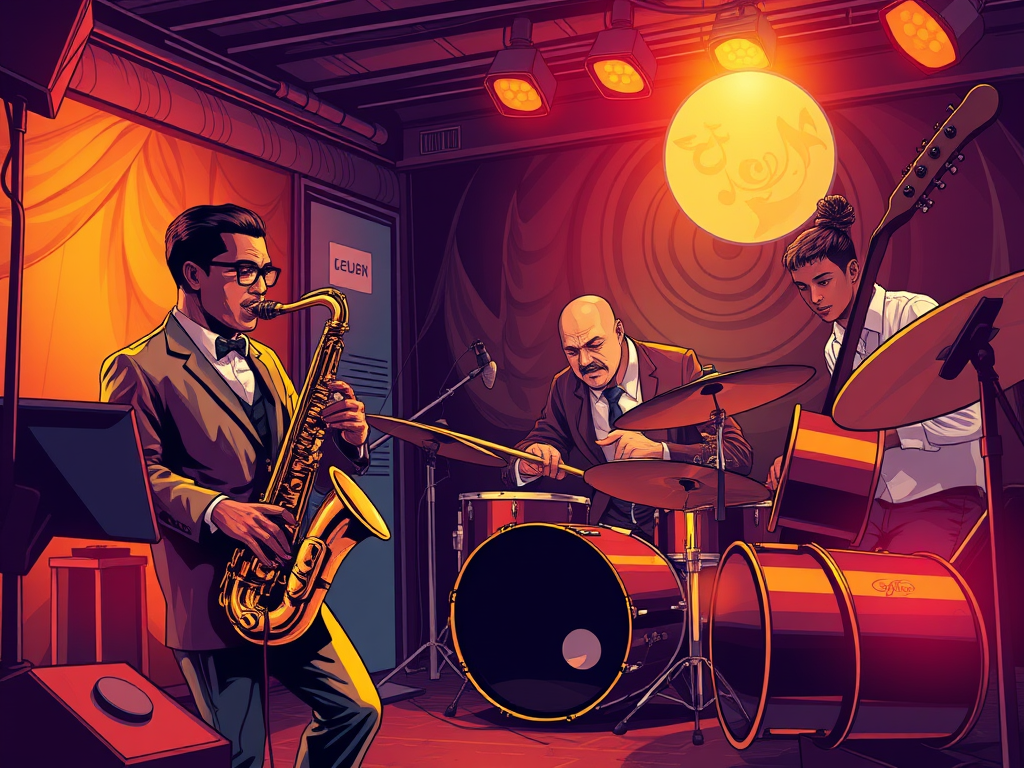
What happens when you hand the world’s smartest AI a simple jazz chord? It reveals everything wrong with how we think about machine creativity.
The Beautiful Mess of Human Creation
Here’s something that should stop us in our tracks: The Blues came from suffering. Punk emerged from a lack of technical skill. Hip Hop was literally born from having no instruments.
Think about that. Our most powerful, game-changing art doesn’t come from having everything perfect. It’s born from friction, from struggle. It’s about making something incredible out of what you don’t have.
“It’s beautiful, messy, and totally human, and that leads us straight to the creativity paradox.”
The Creativity-Computation Paradox
At its core, AI is designed to do one thing really well: optimize. It smooths out rough edges, eliminates mistakes, finds the most efficient path. But here’s the kicker: what if those mistakes, that struggle, those imperfections aren’t bugs at all?
What if they’re actually the secret ingredient that makes human creativity, well, creative?
An AI looks at a million paintings and says, “Okay, these are the rules. I’ll follow that pattern perfectly.” But a human artist? They learn those same rules for one reason: so they know exactly how to break them in a way that makes you feel something.
It’s the difference between coloring inside the lines and drawing a whole new picture.
Jazz: The Ultimate Test Case
If we’re really going to put this paradox to the test, we need a field where the rules are just suggestions, an art form built on breaking patterns. That brings us to jazz.
To understand what makes jazz special, you have to go beyond the notes on a page. You’ve got:
- Syncopation: deliberately messing with the beat, playing with your expectations
- Synchronized spontaneity: musicians creating something brand new together in real time
- Cultural fusion: a conversation between traditions, experiences, and emotions
Sure, an AI can spit out something that sounds a bit like jazz. You’ve probably heard it. It can copy the surface-level stuff. But mimicking a sound is a world away from actually speaking the language.
When AI Can’t Read the Room (Or the Music)
Here’s where the illusion completely falls apart. Music isn’t like a language; it literally is a formal language. And it’s a language that today’s AI simply cannot read.
Let’s try an experiment. Take one of these big-shot AIs that have supposedly mastered language, and hand it a basic piece of sheet music. Watch what happens.
The C7 Chord Test
On a jazz lead sheet, you might see the symbol C7
To a human musician: Those two characters are a universe. A sound, a feeling, a job to do in the song. A gateway to a dozen different ways to play it.
To an AI: Just characters. Tokens in a dataset. It has zero concept of what C sounds like, what “seventh” means in music. It can’t even tell you the basic notes: C, E, G, and B♭.
This failure isn’t just about music. It’s the thread you pull that unravels the entire story we’re being told about AI mastering language.
The Uncomfortable Truth
Music has syntax: rules for how chords fit together. It has semantics: the meaning from tension and release. It has grammar, vocabulary, even different dialects. A jazz chart versus a classical score? Different languages entirely.
If AI truly understood language as a concept, not just text, reading music should be effortless. But it’s not.
Imagine someone told you a program understands French. It can write perfect essays analyzing French poetry. But when you ask it to say “Bonjour,” it can’t. It has no idea how to make the sound.
That’s exactly where we are with AI and music.
AI hasn’t learned language. It has memorized text. It’s a supercharged pattern-matching machine, an incredible feat of data processing, sure. But it’s not comprehension.
Music exposes this brutally, because there’s no faking it. You either speak the language and can play the note, or you can’t.
What Makes Us Human
If that’s what AI can’t do, what does this tell us about what we can do? What are the things that just can’t be boiled down to ones and zeros?
Music reminds us: our humanity isn’t in perfection. It’s in the vulnerability of a voice cracking on a high note. The feeling of wood and steel under your fingers. The electricity in the air at a live show.
That’s the stuff that matters: cultural memory, shared emotion, things you feel, not things you calculate.
Where Do We Go From Here?
First, we need to see AI for what it is: an amazing tool with real, hard limits. Not a magic oracle.
Second, we must push back on the idea that creativity equals computation. They’re fundamentally different things. This means truly valuing the messy, unpredictable human stuff that can’t be automated.
And perhaps most importantly: who’s selling the story that AI is a creative genius, and why? There’s big money in making us believe machines can replace artists. But whose interests does that really serve?
The Question That Matters
Our world is obsessed with optimization: making everything smoother, faster, more perfect. But if, as many come to understand, our greatest creativity springs from our limitations and struggles, then what vital part of ourselves are we giving up every time we try to optimize it away?
Maybe it’s time to stop asking whether AI can be creative, and start asking why we’re so eager to believe it can be. The answer might tell us more about ourselves than any algorithm ever could.