Trying to figure out the world of cloud computing can feel like you’re navigating a giant, constantly changing city. You’ve got public roads, you’ve got private communities, and this whole complex web of highways trying to connect everything. But what if you could have your own super secure, high performance skyscraper right in the heart of it all? Well, that’s exactly what we’re going to explore.
The Current Cloud Landscape
Let’s start by looking at the ground it’s built on. The modern business isn’t just picking one cloud and calling it a day. The reality is that approximately 90% of enterprises are now working with a mix of different cloud models.
Hybrid Cloud isn’t some idea for the future. It is the standard right here, right now. And while adoption hasn’t exactly doubled in 12 months, hybrid cloud market growth exceeded 15% year-over-year, showing significant momentum as businesses scramble to build out infrastructure that can actually keep up.
Source: Business Research Insights
The VPC Foundation
So here’s the bottom line: we are living in a brand new cloud reality. It’s not about picking a single destination anymore. It’s about mastering a complex, interconnected, hybrid, multi-cloud environment. This opens up incredible opportunities, but also brings challenges in management, security, and connectivity.
For many organizations, the foundational answer is the virtual private cloud, or VPC. It’s the architectural tool that helps bring order to the chaos.
What is a VPC?
A VPC is basically your own private, fenced-off area inside a massive public cloud. It gives you the control and security of a private network, but you get all the power and cost-effectiveness of a big public cloud provider. You’re getting the best of both worlds: Private Cloud Control with public cloud economics.
IBM’s LinuxONE Revolution
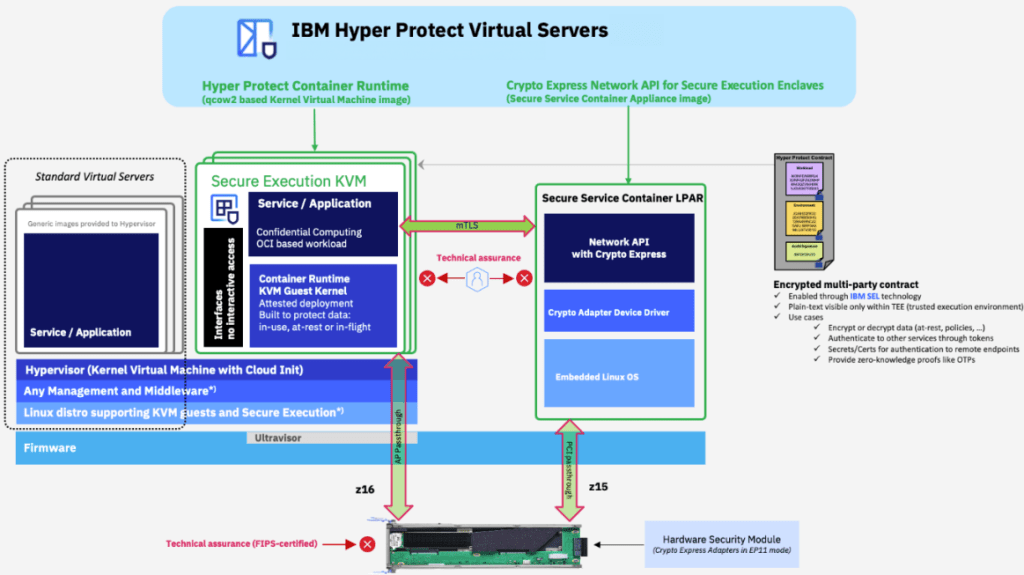
This is where IBM comes into the picture, taking the solid foundation of the VPC and supercharging it. This is the IBM Cloud LinuxONE virtual server for VPC – leveraging the super secure, high-performance architecture of the LinuxONE platform as confidential compute container runtime that you control, right inside the public cloud.
IBM continues to offer LinuxONE virtual servers as part of their Hyper Protect Services, available both on-premises and in IBM Cloud VPC with s390x architecture profiles. For containerized workloads, developers can run container-based workloads on LinuxONE virtual servers with full confidential computing capabilities.
According to IBM’s research, a hybrid strategy can deliver 2.5x more business value than a public cloud-only strategy.
Real-World Success: Enterprise Voice Assistant
Vicom Infinity developed an enterprise-grade voice assistant using IBM’s Hyper Protect Virtual Servers for VPC. The solution processes sensitive voice data with Watson technologies in a security-rich environment that even IBM admins cannot access. This demonstrates how confidential computing enables enterprises to leverage public cloud benefits while maintaining complete data control – exactly what regulated industries like banking and healthcare require.
How Does This Deliver 2.5x Value?
It’s not magic. It’s a combination of real, tangible wins:
- Business acceleration: Speeding up app releases from months to weeks
- Infrastructure cost optimization: Can reduce infrastructure costs by up to 4x in certain scenarios
Core Technology Specifications
✓ FIPS Security: Highest level FIPS 140-2 Level 4 certification – crucial for regulated industries
✓ Confidential Computing: IBM Secure Execution for Linux protects data in-use, in-transit, and at-rest
✓ Developer-Friendly: Standard REST API for easy integration with container-based workload support
✓ Open Source: Built on open source KVM – no vendor lock-in
✓ Enhanced Security: Integrates with Hyper Protect Crypto Services for Keep Your Own Key capabilities
✓ High Performance: Network capabilities up to enterprise-grade speeds
The Developer Perspective
Let’s meet Nick, an enterprise developer. Like most developers, his goal is simple: code and get work done quickly without infrastructure getting in his way. But look at where his time actually goes.
The rest gets consumed by troubleshooting, meetings, and administrative tasks
The key to unlocking productivity is giving developers more of that time back. Here’s a perfect example: vertical scaling. If Nick needs more power, he can dynamically add RAM or CPU to his existing server. Compare that with horizontal scaling, where he’d have to spin up entirely new servers and manage a load balancer. This one feature alone eliminates hours of rework.
For modern containerized applications, developers can now deploy sensitive workloads in highly isolated environments with the same ease as traditional cloud deployments – but with confidential computing protection that ensures even cloud providers cannot access their data or code.
This makes it an absolutely perfect tool for development and testing in a hybrid world. Imagine being able to build and test your app in a cost-effective cloud environment that is an exact replica of your high-security on-premise system. You can test with total confidence and then deploy securely, all within one single unified IBM cloud experience.
Getting Started: Four Simple Steps
Deploy
Choose your profile size and hit Deploy
You can have a LinuxONE virtual server up and running in minutes. Use promo code VPC1000 for a free trial of Hyper Protect Virtual Servers.
Key Takeaways
✓ Cost Savings: Amazing cost savings and scale of public cloud
✓ Security: Rock-solid security advantages with confidential computing
✓ Business Value: Up to 2.5x more value with hybrid strategy
✓ Modernization: Accelerate time to market and modernization efforts
✓ Container Support: Run containerized workloads with zero code changes
✓ Regulatory Compliance: Meet GDPR, HIPAA, and other regulatory requirements
The Real Question
At the end of the day, the real question isn’t about the technology itself. It’s about what it unlocks for you. When your infrastructure is this secure, this performant, and this scalable, what will you build next?
All statistics and claims have been fact-checked and updated with current market data as of September 2025. Sources include IBM official documentation, and industry research from firms such as Future Market Insights and Business Research Insights.