Introduction
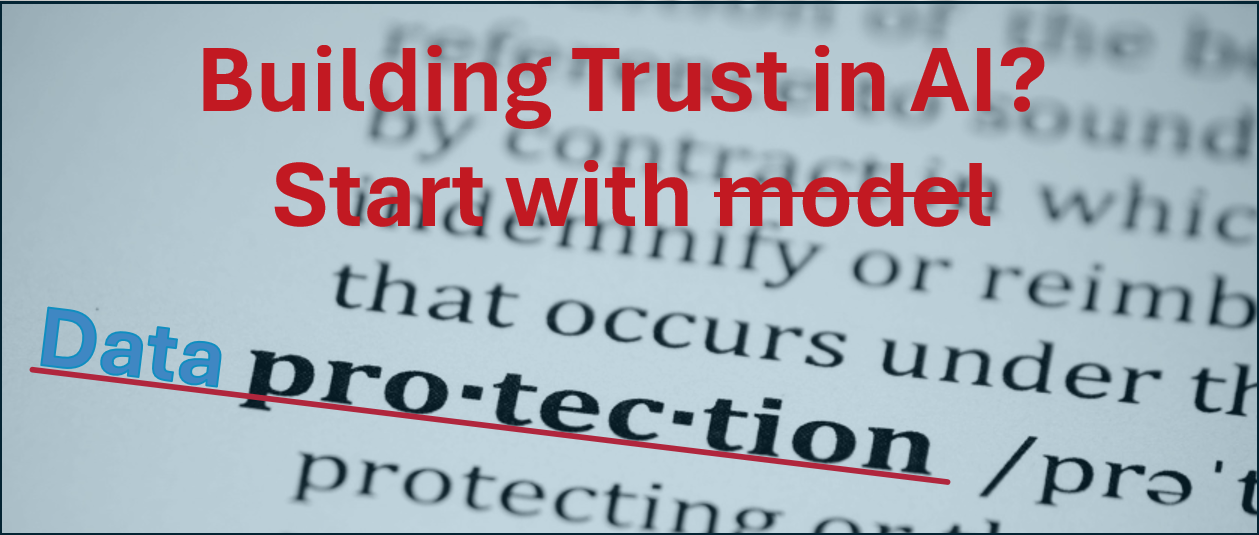
In the race to advance AI technology, it’s easy to get caught up in the complexities of model development and overlook the fundamental importance of data security and integrity used to train the model. However, these aspects serve as the foundation for tackling the challenges of building trustworthy AI systems. With a range of proven tools and techniques readily available for data protection, focusing on this area is a logical and essential first step. This blog explores why data security should be a top priority, acknowledges the complexity of achieving perfect AI models, and proposes a pragmatic approach to building trustworthy AI systems.
The Importance of Data Security
Building Trust Starts with Secure Data
The adage “garbage in, garbage out” perfectly describes the direct impact of data quality on AI model performance. If the training data is inaccurate or compromised, the resulting AI model will magnify the consequences. By securing the data, we control the foundation on which AI models are built. Established practices and methods for ensuring data integrity should be the starting point for developing trustworthy AI.
Focusing on Models: A Complex Endeavor
The Quest for a Perfect AI Model: A Complex Challenge
Achieving a completely unbiased and perfect AI model is far more complex than focusing on data protection. Model perfection echoes the debates around open-source and third-party supply-chain software challenges, where broad agreement on Software Bills of Materials (SBOMs) standards and compliance are unresolved. Both fields strive for perfection to minimize bias and unintended consequences. In the meantime, both need help with security, transparency, and universally accepted best practices.
Prioritize Data Protection, But Learn from Open Source
While the ideal model is an ongoing goal, we can’t let this fact impede immediate action. Data protection is today’s achievable, impactful objective and the first step toward reliable AI. Open-source development offers lessons for tackling AI model complexity. Tracking code provenance and version control encourages data lineage and monitoring within AI systems. Vulnerability scanning tools inspire approaches for detecting and mitigating biases. Explainable AI (XAI) techniques strive to reveal the logic behind AI model decisions, adding much-needed transparency.
The Challenge of Defining Trustworthy AI
One of the biggest headaches in AI is that even the smartest systems can be biased or unreliable. We haven’t agreed on what makes an AI ‘unbiased’ or ‘reliable.’ It’s like trying to judge a gymnastics competition without clear standards when the rules keep changing, which makes it almost impossible to know if an AI system deserves our trust.
Control the Controllable: Focus on Data
But here’s the good news: the data used to teach AI systems is something we can control. Unlike those complicated AI brains, data security is a clearer problem, with existing rules and best practices. Ensuring model training data is appropriately protected and used responsibly is a non-negotiable part of creating an AI we can trust.
Luckily, many companies know how to secure data and implement robust data protection measures, such as discovery/classification, encryption, user access controls, behavior activity monitoring, and privacy-preserving technologies like differential privacy. By carefully using existing tools and skills for AI projects, we ensure that we build these systems on solid ground. Focusing on AI training data security/privacy protections is one of the best ways to start building AI people can believe in.
Establishing a universally accepted standard for a fully trustworthy AI system is an ongoing aspirational challenge; however, securing the data used to train the model is a straightforward and essential objective we can achieve. It’s a win-win: we improve AI’s fairness, reliability, and data security all at once.
A Pragmatic Approach to AI Development
Don’t let the pursuit of model perfection hinder progress in building trustworthy AI. Tackle a critical and achievable aspect of AI development by emphasizing training data protection from the outset. Secure the training data foundation today and continuously strive to address the more complex issues of unbiased model compliance and accountability.
Conclusion
Building trustworthy AI is an ongoing process that involves both complex goals and actionable steps. While we strive to define and achieve perfect AI models, we must consider the immediate need for data security. By applying proven techniques for data protection, we directly address a fundamental pillar of trustworthy AI. This pragmatic approach positions us to create AI systems that have the potential for reliability and fairness and meet established data security standards – the ideal combination for earning user trust.