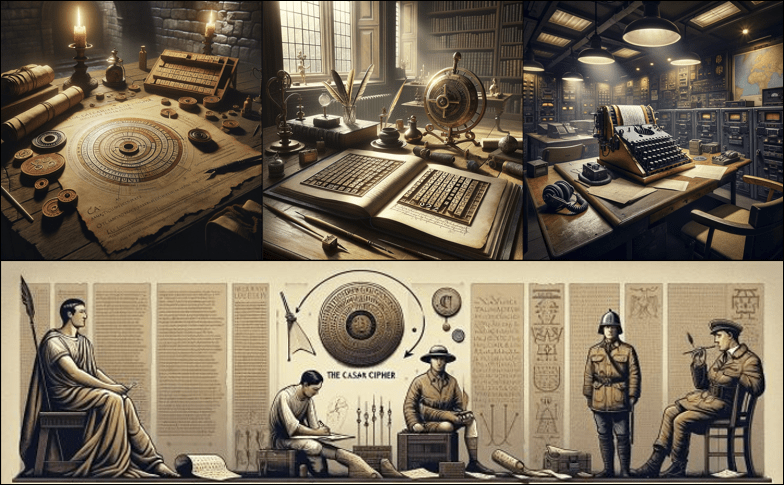
The previous blog, “The Building Blocks of Secret Communication,” explored the transformation of messages for secrecy. Today, we delve into the fascinating history of iconic ciphers, revealing the ingenuity behind their design.
Historical Ciphers
Cryptography’s story is a testament to human creativity across millennia, showcasing the evolution from simple to intricate codes. This journey reveals an ongoing duel between cryptographers, who craft codes, and cryptanalysts, who endeavor to break them. We examine key moments in this history.
The Caesar Cipher: Pioneering Substitution
The Caesar Cipher stands as one of the first encryption techniques. Named after Julius Caesar, who used it to safeguard his messages, this method substitutes each letter with another fixed number of positions down the alphabet. For instance, with a shift of 3, ‘A’ becomes ‘D.’ This technique allowed Roman generals to encrypt orders, keeping them hidden from foes.
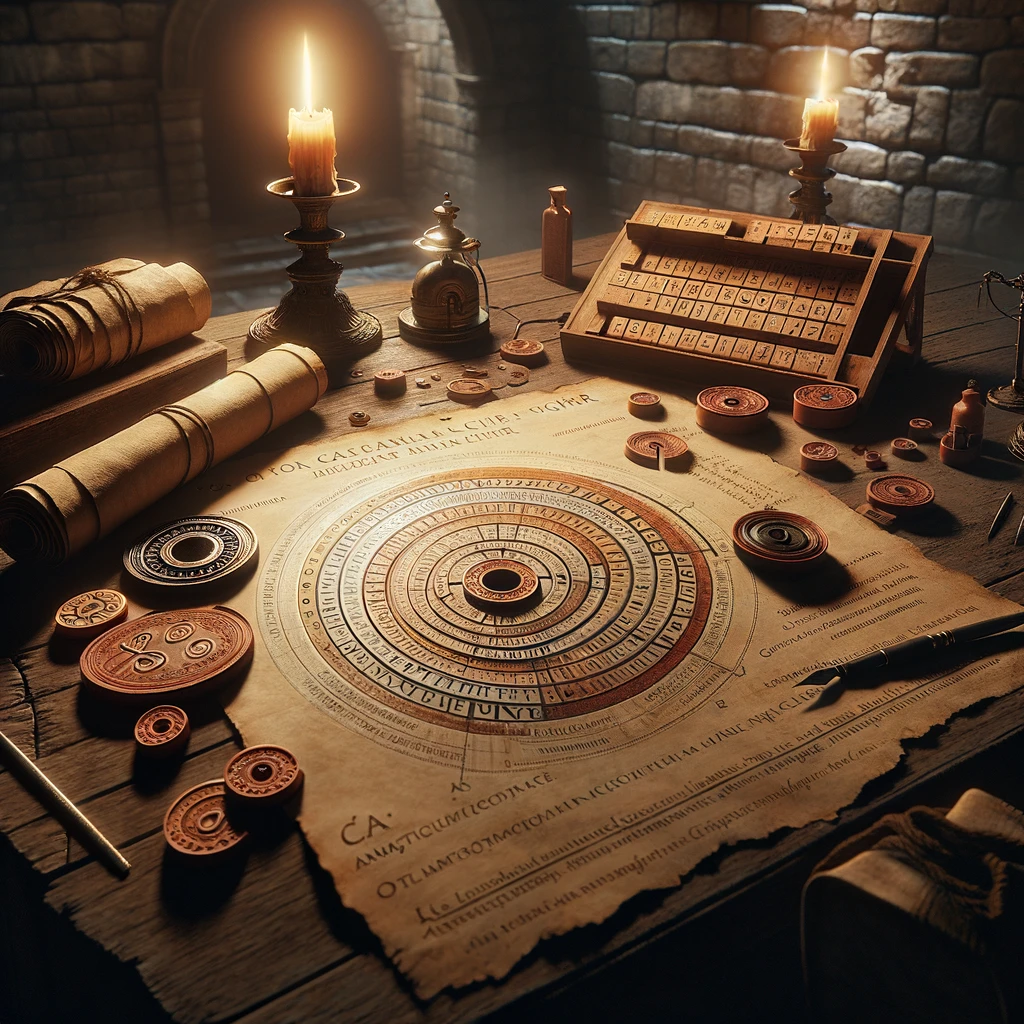
Its simplicity, however, also rendered it vulnerable. With just 26 possible shifts, adversaries could easily crack it through brute force or frequency analysis. Despite this, its underlying principle has significantly influenced cryptography, transitioning from a practical tool in ancient Rome to a foundational educational example in the study of encryption.
The Vigenère Cipher: Advancing Complexity
Developed in the 16th century, the Vigenère Cipher marked a leap in cryptographic complexity with its polyalphabetic system. It uses a keyword to vary the letter shift, complicating letter frequency analysis and allowing the same plaintext letter to encrypt differently depending on its position relative to the keyword.

Renaissance spies favored the Vigenère Cipher for its enhanced secrecy over the simpler Caesar Cipher, proving invaluable for espionage. Nevertheless, by the 19th century, cryptanalysts had devised techniques to break it by identifying key patterns. Its use spanned from the 1500s to the late 1800s, reflecting a significant period in cryptographic history where it moved from cutting-edge to a study subject due to its vulnerabilities.
The Enigma Machine: Mechanical Encryption’s Zenith
The Enigma machine, Germany’s encryption marvel during World War II, signified a monumental stride in cryptography. Introduced in the 1920s and refined through the war, it featured a complex system of rotors and plugboards, enabling countless configurations. Its daily setting changes presented a formidable challenge to codebreakers.

Standing as a pinnacle of mechanical encryption, the Enigma machine’s decryption by Allied cryptanalysts, notably led by Alan Turing at Bletchley Park, underscored a critical lesson: no encryption system is waterproof. This episode marked a pivotal moment in cryptographic history and demonstrated cryptography’s significant impact on global events.
Reflecting on Cryptography’s Evolution
The back-and-forth between cryptographers and cryptanalysts has driven the advancement of encryption technologies. From the Caesar Cipher’s basic shifts to the Enigma’s mechanical intricacies, these historical ciphers illustrate humanity’s relentless quest to secure its communications. They embody the continuous journey toward unbreakable encryption, reminding them that this pursuit is an ongoing process, not a destination. As we look to the future, past lessons inspire new generations to forge ahead in the cryptographic saga.
Up Next: Modern Security Foundations
While ingenious, cryptanalysts eventually deciphered (cracked) these historical ciphers. Today, our reliance on more sophisticated encryption underscores the evolution of secure communication.
In our next blog we will explore “Symmetric Key Cryptography,” the cornerstone of today’s digital security. Stay tuned for an insight into the mechanisms safeguarding our digital world.