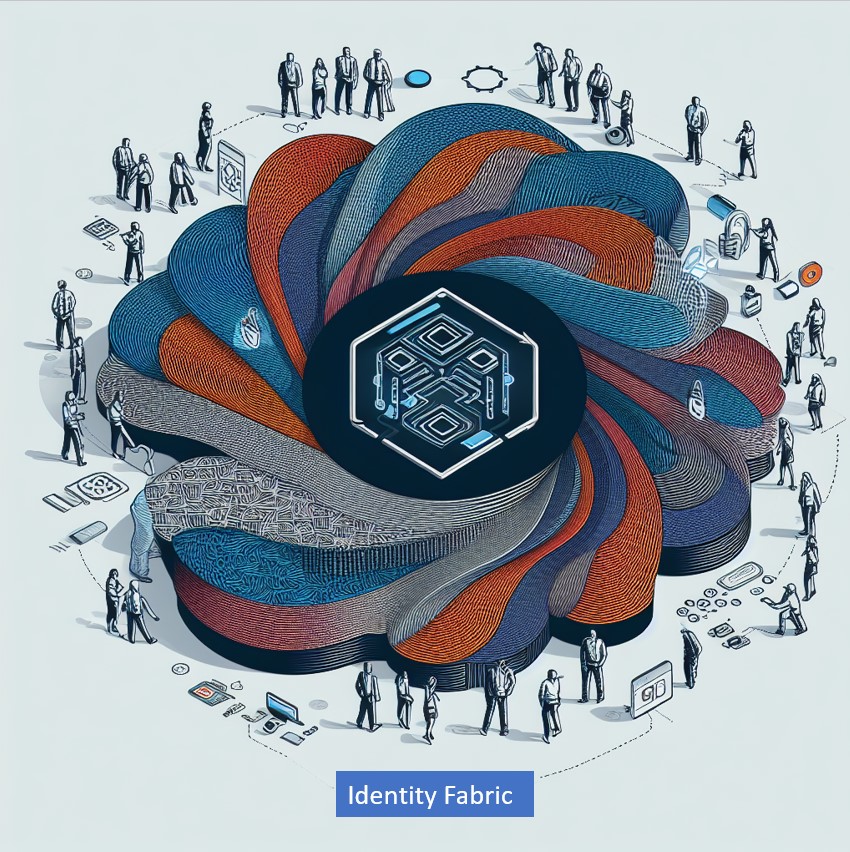
An Identity Fabric is an advanced architectural concept in identity and access management (IAM). It represents a comprehensive, strategic approach to managing identities across various platforms, applications, and devices. This concept is especially relevant in modern IT environments, which often encompass multi-cloud and hybrid cloud infrastructures.
Core Components of an Identity Fabric:
- Multi-Cloud Identity Management Framework: It functions as an abstraction layer within this framework, enabling the management of multiple identity domains across different cloud environments.
- Orchestration and Abstraction: The identity fabric utilizes orchestration to manage these identities efficiently. Through abstraction, it works identities across any Identity Provider (IDP), whether on-premises or cloud-based. This approach helps in unifying access policies across different cloud vendors and simplifies the integration of modern authentication protocols without the need to rewrite applications.
- Consistency Across Distributed Environments: By orchestrating disparate environments, an identity fabric ensures consistent identity and access policy management throughout the network, regardless of whether the resources are in multi-cloud or hybrid cloud setups.
- Integration and Mapping: The abstraction layer inventories and maps elements of the extended identity system across multiple clouds, creating a connected layer that intertwines legacy infrastructures with modern cloud-based assets.
- Unified Identity Providers and Infrastructures: It integrates components such as Multi-Factor Authentication (MFA), directories, databases, APIs, and authentication and authorization providers into a cohesive system.
- Developer-Friendly Interface: Developers can leverage a single abstracted API for a wide range of connected systems, ensuring consistent identity and access management across multiple clouds and vendors.
- No-Code or Low-Code Integration: An identity fabric eliminates the need for custom coding of identity management into applications for cloud deployment, streamlining the process significantly.
IBM’s offerings in this domain include:
- IBM Security Verify: This is a suite of identity solutions that aid in simplifying identity management across hybrid environments and building an identity fabric with product-agnostic tools.
- IBM Security Verify Directory: A standalone solution focusing on eliminating identity silos by providing a unified, authoritative directory for smooth access control.
- IBM Security Application Gateway: This solution integrates legacy applications with modern IAM solutions, offering no-code integrations and enhancing user experience.
- IBM Security Verify Trust: This tool provides real-time, risk-based authentication with AI-powered risk assessment, combining various data sources for a comprehensive security approach.
In summary,
An identity fabric is a holistic architectural approach to managing diverse identities across platforms, applications, and devices. It is a flexible mesh that integrates disparate identity and access management (IAM) tools into a unified system. This fabric enables:
- Centralized control: Manage user access and permissions from a single point, simplifying administration and streamlining user experience.
- Seamless access: Users authenticate once and gain access to authorized resources across various platforms, regardless of underlying technology.
- Enhanced security: Continuously verify user identities and enforce access controls at every touchpoint, minimizing vulnerabilities and data breaches.
- Adaptability and scalability: Easily integrate new technologies and expand the fabric to accommodate organizational growth and evolving needs.
An identity fabric empowers architects to design secure, efficient, and user-friendly identity management systems for complex, modern infrastructures.
IBM Security Verify provides a means to achieve an identity fabric by providing the foundational building blocks enabling clients to build an identity fabric to solve the identity challenges created by cloud migration and digital transformation.
It helps eliminate identity silos, improves user experience across all apps by extending modern authentication mechanisms to legacy apps with no-code changes, enables a consistent user experience across all applications, and improves security posture with real-time behavioral and biometric risk assessment.
IBM Security Verify products provide innovative identity and access management for the hybrid, multi-cloud enterprise to help deliver automated, cloud-based, and on-premises capabilities for administering identity governance, managing workforce and consumer identity and access, and controlling privileged accounts.
IBM’s Identity Fabric and Security Verify solutions unify diverse identity management landscapes, enhance security, improve user experience, and support scalability.
.