Change Healthcare Cyberattack: Impacts, Responses, and Lessons Learned
How one remote-access login without multi-factor authentication stopped claims processing across U.S. healthcare in 2024, and what providers and their vendors should do now.

Introduction
Picture a small practice in late February 2024. Claims will not go out, prior authorizations stall, and the owners start covering payroll from their own savings. Many practices and hospitals lived that after the attack on Change Healthcare, a UnitedHealth Group (UHG) company whose clearinghouse, by its own count, processes 15 billion health care transactions a year and touches one in three patient records. One stolen password on one remote-access portal led there.
Timeline of events
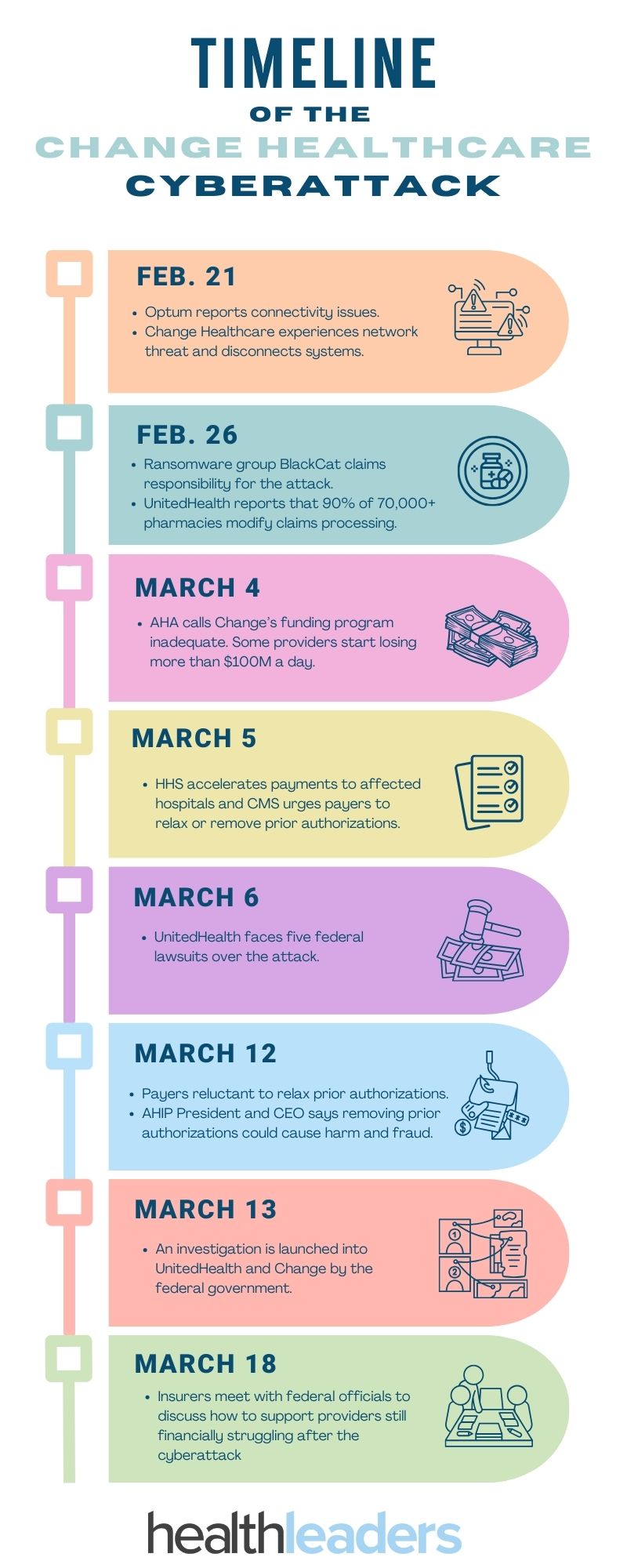
February 12 to 29: entry, attack and disconnection
UHG’s chief executive, Andrew Witty, told the Senate Finance Committee on May 1, 2024 that on February 12 criminals used compromised credentials to reach a Change Healthcare Citrix remote-access portal that did not have multi-factor authentication. Nine days later, on the morning of February 21, the attackers deployed ransomware, and UHG disconnected Change Healthcare’s systems to contain it. UHG’s first filing with the Securities and Exchange Commission blamed a suspected nation-state actor; by February 29, Change Healthcare said the attacker had represented itself as the ALPHV/BlackCat ransomware group.
March: relief payments and surveys
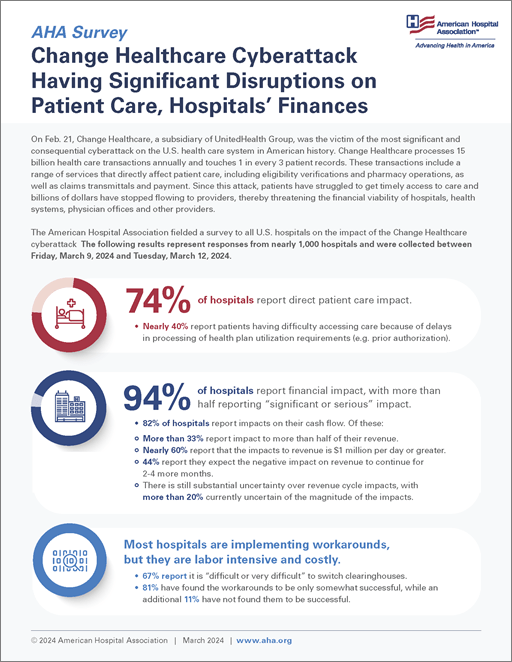
On March 9, the Centers for Medicare & Medicaid Services (CMS) offered accelerated payments to Medicare Part A providers and advance payments to Part B suppliers. On March 15 it told states how to make interim payments to Medicaid fee-for-service providers. The American Hospital Association (AHA) surveyed hospitals in mid-March: 94% of the 960 that answered reported a financial impact, and 74% reported a direct impact on patient care. On March 22, UHG said Change Healthcare would start processing a claims backlog of more than $14 billion as its clearinghouse came back online.
April: ransom confirmed
On April 22, UHG confirmed that it had paid a ransom to protect patient data, and that files with protected health information covering a substantial proportion of people in America may have been taken. Witty later told Congress the payment was about $22 million in bitcoin, and that the data could cover about a third of Americans.
Impact of the cyberattack
Financial and operational disruption
Without claims flowing, providers lost the cash that pays staff and suppliers. In an American Medical Association survey run from March 26 to April 3, 2024, 80% of physician practices reported lost revenue from unpaid claims, and 55% had used personal funds to cover practice expenses. By April 16, UHG had provided more than $6 billion in advance funding and interest-free loans to affected providers; many hospitals told the AHA the help covered only a small share of their losses.
Patient care and data
The AHA survey found that hospitals struggled with authorizations for medically necessary care, and the ransom did not guarantee the stolen data would stay off the dark web.
Responses
On March 13, 2024, the Department of Health and Human Services’ Office for Civil Rights opened an investigation into Change Healthcare and UHG under HIPAA. Congressional committees in both houses held hearings, and Witty testified before the Senate Finance Committee and a House Energy and Commerce subcommittee on May 1, 2024.
Lessons for providers and their vendors
- Require multi-factor authentication on every remote-access path. The attack started at one portal without it. Your IT team or provider owns this; ask vendors to confirm it in writing.
- Know which outside services your revenue depends on. List your clearinghouse, billing and authorization vendors, and agree a manual or alternate route before you need it.
- Plan for cash flow, not only systems. Know in advance how you would request advance payments from payers and CMS, and how long your reserves last.
- Practice the response. Run a short tabletop exercise with clinical, billing and IT leaders on a “clearinghouse down for a month” scenario.
Sources
- U.S. Senate Committee on Finance. (2024, May 1). Testimony of Andrew Witty, Chief Executive Officer, UnitedHealth Group. finance.senate.gov
- U.S. House Committee on Energy and Commerce. (2024). What we learned: Change Healthcare cyberattack. energycommerce.house.gov
- American Hospital Association. (2024, March 20). Congress urged to help hospitals impacted by Change Healthcare cyberattack. aha.org
- American Hospital Association. (2024, April 16). Testimony to the House Energy and Commerce Subcommittee on Health. aha.org
- Centers for Medicare & Medicaid Services. (2024, March 9). CMS statement on continued action to respond to the cyberattack on Change Healthcare. cms.gov
- American Medical Association. (2024, April 10). Physicians struggle to keep practices afloat after Change cyberattack. ama-assn.org
- UnitedHealth Group. (2024, April 16). UnitedHealth Group reports first quarter results. unitedhealthgroup.com
- The Record by Recorded Future News. (2024, February 29). Change Healthcare ransomware attack and BlackCat/ALPHV. therecord.media
- U.S. Department of Health and Human Services, Office for Civil Rights. (2024, March 13). Letter to health care organizations on the Change Healthcare cyberattack. hhs.gov