A cloned CEO voice can trigger a wire transfer, and staff paste data into public AI. Firewalls stop neither.
How generative AI changes cyber risk for a business, from voice-clone fraud to staff pasting data into public AI tools, and which frameworks help you respond.
Key Takeaways
- Phishing no longer looks sloppy: AI writes fluent, personal messages, so training has to teach staff to verify requests, not just spot typos.
- Shadow AI is a quiet internal leak: Employees using public AI tools may be exposing sensitive data without knowing it.
- Detect behavior, not just indicators: Blocking known IP addresses and file signatures still helps, but it is not enough on its own.
- Frameworks exist to guide you: OWASP, NIST, and the EU AI Act provide actionable paths to AI governance.
Picture a CFO at a mid-sized manufacturing company taking a call from the CEO. “We need to wire $2.3 million for the acquisition we discussed. I’m sending the details now.” The voice is unmistakable. The urgency is typical. The transfer is approved in 47 minutes.
The CEO never made that call. The voice was synthetic, generated by AI from a few minutes of audio taken from earnings calls and podcasts.
That scenario is not far-fetched. In 2024, an employee at the engineering firm Arup in Hong Kong transferred about US$25 million after a video call in which the company’s CFO and colleagues were all deepfakes. In 2025 the FBI warned that criminals were using AI-generated voice messages to impersonate senior U.S. officials.
For years, cyber attacks followed patterns that defenders could study and build defenses around. Generative AI has not changed what attackers want, but it has made their attacks cheaper, faster and more convincing.
The same technology that powers your customer service chatbot and writes your marketing emails is now being used to craft attacks that your current defenses simply weren’t built to detect.
Two Numbers Worth Knowing
- Three seconds: McAfee researchers reported in 2023 that as little as three seconds of audio was enough to produce a voice clone with an 85% match (McAfee, 2023).
- US$4.44 million: the global average cost of a data breach in IBM’s 2025 Cost of a Data Breach Report, which also found that 97% of organizations that reported an AI-related breach lacked proper AI access controls (IBM, 2025).
What those numbers don’t capture: the complete transformation of how attacks happen, who can launch them, and why traditional defenses are failing.
How We Got Here: A Brief History of Digital Defense
To understand why AI changes everything, you need to understand what came before.
For decades, cyber attacks have followed a predictable sequence. Security professionals call it the Cyber Kill Chain—seven stages that every successful attack must complete. Think of it as a burglar’s checklist: case the house, pick the lock, disable the alarm, grab the valuables, escape.
Lockheed Martin published the model in 2011. Its value is that it gives defenders several chances to stop an attack: break any link in the chain, and the operation fails. It never worked perfectly, but it helped make cybersecurity a structured discipline with clear practices.
Then generative AI arrived.
The Three Transformations You Need to Understand
AI has changed three things about cyber risk:
1. The End of the Obvious Attack
Then
Phishing emails had obvious tells: broken English, generic greetings, suspicious urgency. Training employees to spot them actually worked.
Now
AI generates fluent, personalized messages that reference your current projects, mimic your colleagues’ writing styles, and arrive at precisely the right moment.
What This Means for Your Business
An annual phishing course is no longer enough on its own. When an email copies your CEO’s style, names a real project and arrives while you are waiting for approval on that project, even careful employees can be fooled. The defense that still works is process: call back on a known number before moving money or changing payment details, and require a second approver for large transfers.
2. The Barrier to Entry Has Collapsed
Then
Launching sophisticated attacks required years of technical training, specialized tools, and significant resources. Serious threats came from organized groups.
Now
Less skilled attackers can use AI tools to write convincing pretexts, translate lures into any language and get help with code. Commercial AI services have safeguards, but criminal services and jailbroken models fill the gap.
The Uncomfortable Truth
Sophisticated nation-state and criminal groups remain the biggest threat, but the pool of people able to run a convincing scam has grown.
3. The Target Is Now the AI Itself
This is the shift most businesses haven’t grasped yet.
If your organization uses AI tools—and increasingly, every organization does—those AI systems themselves become attack targets. Not the servers they run on. Not the databases they access. The AI’s reasoning itself.
Traditional Security
Strict separation between “instructions” (code) and “data” (information). You could protect each independently.
AI Security
Instructions and data blur together. An attacker can manipulate the AI’s behavior simply by crafting the right input—no “hacking” required.
Five Risks from the OWASP Top 10 for LLM Applications
The OWASP Top 10 for LLM Applications (2025), from the nonprofit Open Worldwide Application Security Project, lists the most critical risks in applications built on large language models. Five that matter to most businesses:
| Vulnerability | What It Means for Your Business |
|---|---|
| Prompt Injection | Attackers craft inputs that trick your AI into ignoring its rules. Imagine your customer service bot suddenly sharing confidential pricing or internal policies because someone asked it the “right” way. |
| Sensitive Information Disclosure | Your AI inadvertently reveals sensitive information in its responses—customer data, proprietary processes, or competitive intelligence it was trained on. |
| Data and Model Poisoning | If attackers can corrupt the data used to train your AI, they can create hidden backdoors—like teaching the AI to automatically approve certain transactions or ignore specific red flags. |
| Misinformation | AI “hallucinations”—confident but completely wrong answers—get treated as fact, leading to flawed decisions, legal exposure, or customer harm. |
| Supply Chain | The AI models and plugins you integrate may contain vulnerabilities you can’t see or control. Do you know what’s really inside the tools you’re using? |
The Threat Inside Your Walls: Shadow AI
While you’re focused on external attackers, there’s a threat inside your organization that might be more immediate—and it’s driven by your best employees.
The Shadow AI Problem
Your marketing lead pastes customer feedback into ChatGPT to draft a response. Your developer copies proprietary code into an AI assistant for debugging help. Your analyst uploads a confidential spreadsheet to an AI tool for visualization.
Each one may have sent company or customer data somewhere the company does not control.
Shadow AI happens because:
- Good intentions: Employees genuinely want to be more productive
- Easy access: Public AI tools are powerful and often free
- Invisible risk: There’s no alarm when data leaves via a browser tab
- Policy gaps: Most organizations haven’t addressed AI use
Your firewall can’t stop it. Your antivirus won’t detect it. It looks exactly like normal web browsing—because it is.
A Simple Policy Fix
The fastest way to address Shadow AI risk: Enterprise AI vs. Public AI.
Consumer accounts of tools such as ChatGPT, Microsoft Copilot and Claude may use conversations to improve their models, depending on the account’s settings, and lack business controls. Business and enterprise plans (for example ChatGPT Enterprise, Microsoft 365 Copilot and Claude’s Team and Enterprise plans) add administrative controls and audit logs, and their terms say your content is not used for training by default.
The policy is simple: use company-approved enterprise AI tools for any work involving internal data. Public tools are fine for general research—but the moment sensitive information is involved, switch to the enterprise version.
The Pyramid of Pain: A Smarter Defense Strategy
Here’s the concept that separates mature security programs from reactive ones.
Not all defenses are equal. Some actions cause attackers minor inconvenience; others force them to completely rebuild their approach. The Pyramid of Pain, introduced by security researcher David Bianco in 2013, ranks your defensive options by how much difficulty they create for attackers:
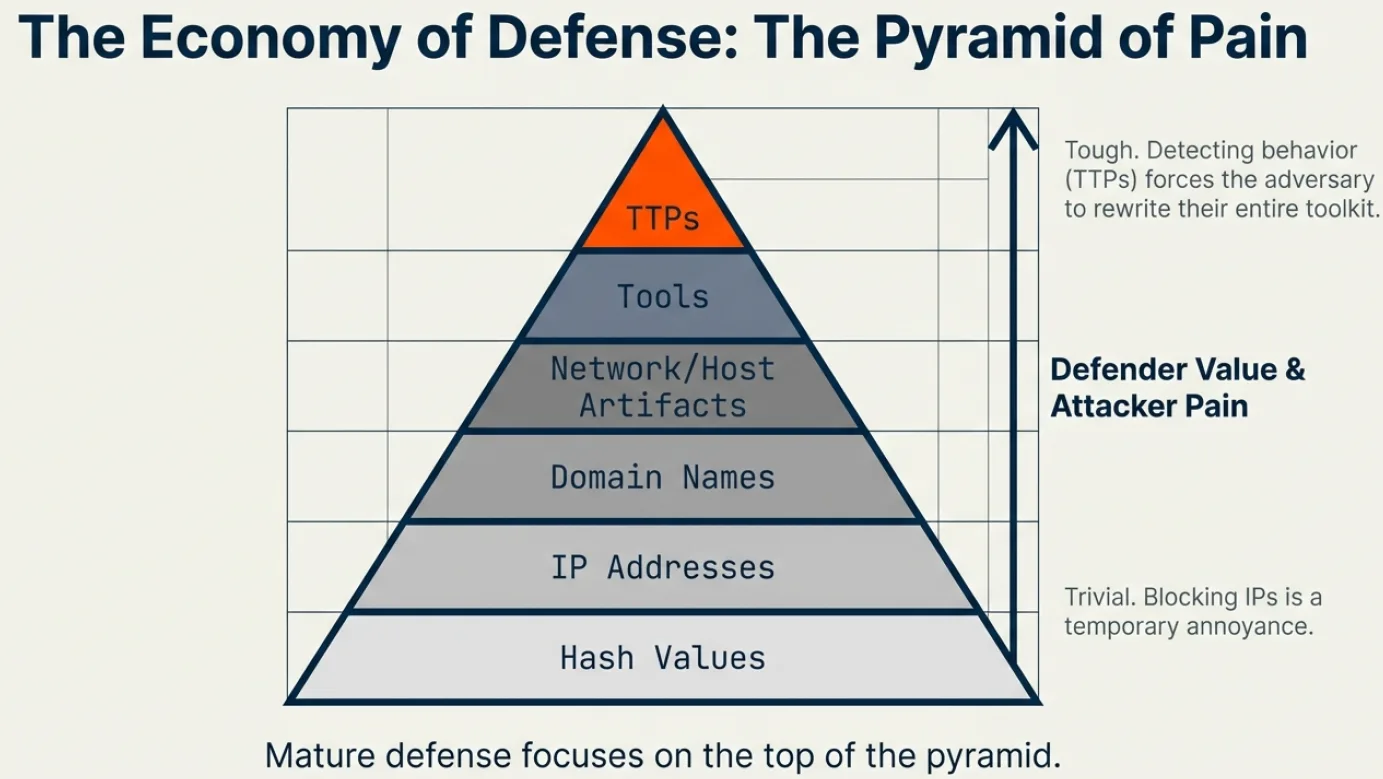
The Pyramid of Pain: Focus your defenses on behaviors (TTPs) at the top, not easily-changed indicators at the bottom.
The bottom line: If your security program focuses on blocking known bad IP addresses and file signatures, you are only covering the easiest part of the problem. Modern defense also detects behavior—the patterns that define how attackers operate, not just the specific tools they happen to use today.
The Frameworks That Can Guide You
You don’t have to figure this out alone. Several established frameworks provide guidance for managing AI and cyber risk:
🏛
NIST AI Risk Management
The U.S. government’s comprehensive framework for trustworthy AI development, including testing, evaluation, verification, and validation protocols.
🛡
OWASP Top 10 for LLM Applications
A community-built list of the most critical risks in applications that use large language models.
🗺
MITRE ATT&CK + ATLAS
Mapping traditional attack techniques alongside AI-specific threats for comprehensive, behavior-based defense.
🌐
EU AI Act
The EU’s AI law, in force since August 2024. Its bans on certain practices have applied since February 2025 and its rules for general-purpose AI models since August 2025; most remaining obligations are scheduled for August 2026, though the European Commission proposed in November 2025 to delay some high-risk rules. It applies to U.S. companies whose AI systems are used in the EU.
The Critical Question: Where Do You Stand?
Every business leader needs to understand the gap between their current security posture and where they need to be. This isn’t about fear—it’s about informed decision-making.
Honest Self-Assessment
- Do we have visibility into which AI tools our employees are actually using?
- Have we established clear, practical policies for AI use with sensitive data?
- Are our defenses built to detect attacker behavior, or just known threats?
- Do we understand the AI components embedded in our vendor applications?
- Have we assessed our AI systems against the OWASP Top 10 for LLM Applications?
- Is our incident response plan updated for AI-enhanced attack scenarios?
- Do we keep an inventory of the AI models, services and components we rely on (sometimes called an AI bill of materials)?
- Are we tracking new regulatory requirements (EU AI Act, state laws)?
If you answered “no” or “I don’t know” to more than two of these questions, you have a gap that needs attention.
That gap is worth closing before it shows up as a call from your bank, your lawyer or your largest customer.
The Path Forward
The AI-driven threat landscape is real, but so is your ability to respond. The organizations that thrive won’t be the ones who ignore these risks or panic about them—they’ll be the ones who take measured, informed action.
Start with visibility. Move to policy. Build toward behavioral defense. Integrate AI governance into your existing risk management.
The goal isn’t perfect security. It’s understanding your risk and making smart decisions about how to manage it.
Want to talk it through?
Book a free 30-minute call with Security Medic Consulting.